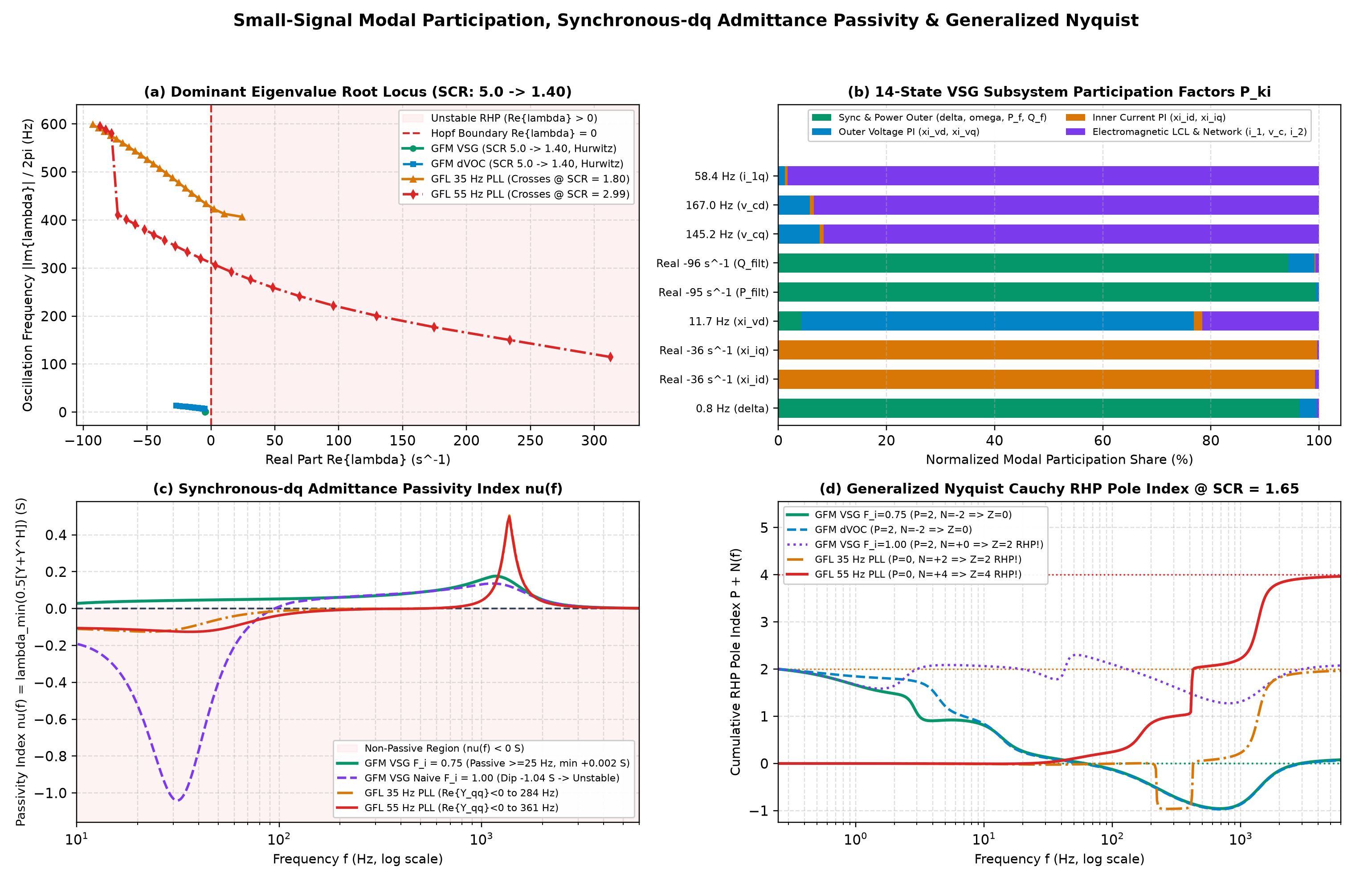
Figure 1, Small-Signal Modal Participation, dq Admittance Passivity & Generalized Nyquist
14-state VSG participation matrix P_ki, Qoria F_i = 0.75 passivity restoration (min nu >= 25 Hz = +0.0019 S vs. F_i = 1.00 dip -1.04 S), and exact Z = P + N.
Interactive browser-side 4th-order Runge-Kutta (dt = 250 us) electromagnetic fault & weak-grid
simulator coupled with exact Python state-space modal participation, synchronous-dq admittance
passivity nu(f), and Generalized Nyquist Z = P + N datasets.
(Model-consistency research workbench only, not hardware or grid-code certification.)
dq Admittance Passivity & Nyquist (SCR = 1.65, P = 15 kW)
| Converter Architecture | min nu (f >= 25 Hz) | Non-Passive Band (>= 25 Hz) | Negative Re{Y_qq} Band | Stiff-Bus RHP P | Nyquist Winding N | Closed-Loop Z = P + N |
|---|
All 6 publication figures are deterministically generated by python main.py and verified in CI
across Python 3.10–3.13 against state-space eigenvalues, SciPy RK45, and Generalized Nyquist invariants.
14-state VSG participation matrix P_ki, Qoria F_i = 0.75 passivity restoration (min nu >= 25 Hz = +0.0019 S vs. F_i = 1.00 dip -1.04 S), and exact Z = P + N.
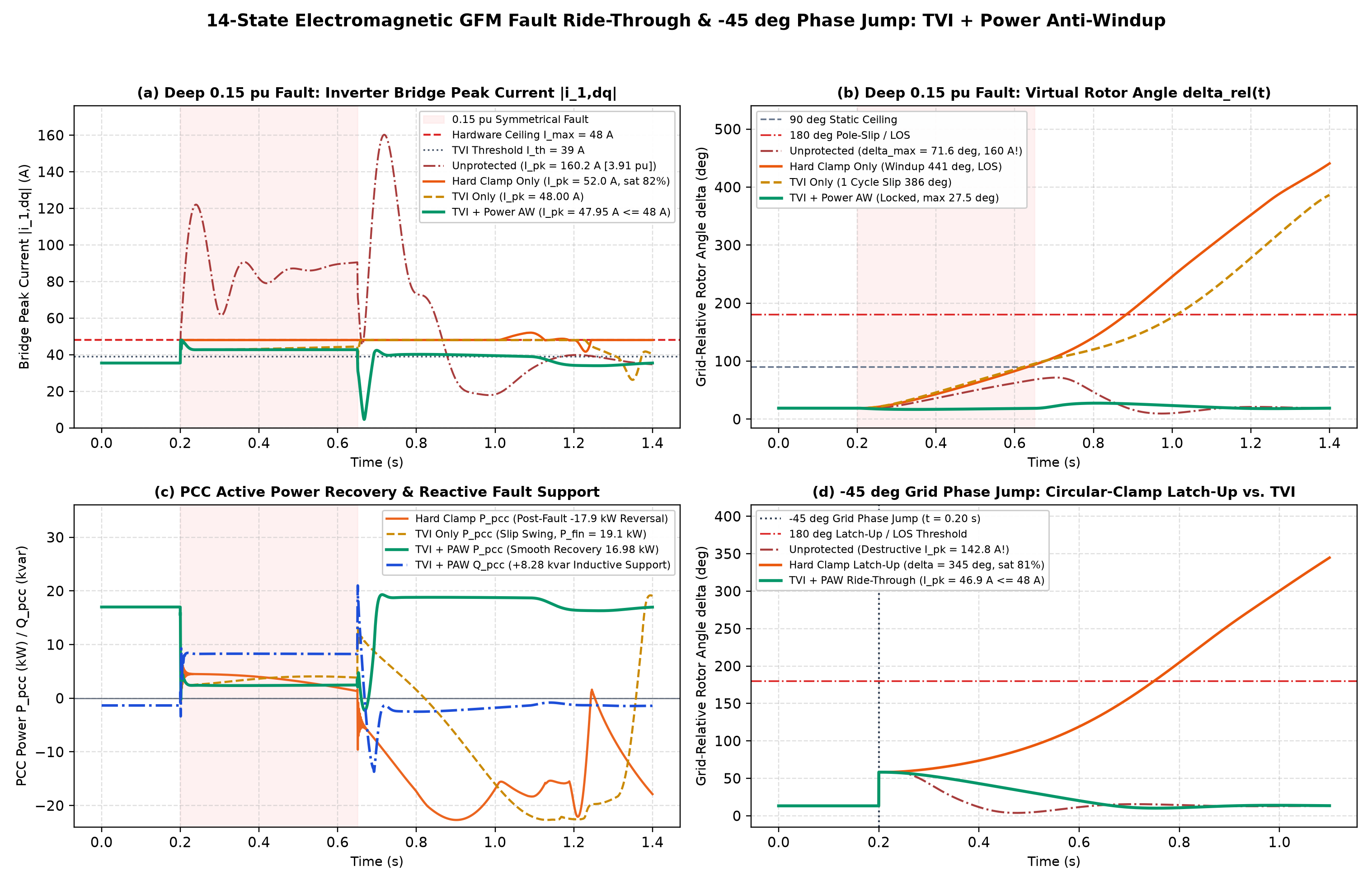
Unprotected 160.2 A spike & Hard-Clamp 440.7° windup LOS vs. coordinated TVI + PAW (I_pk = 47.95 A <= 48 A, max delta = 27.5°, zero cycle slips).
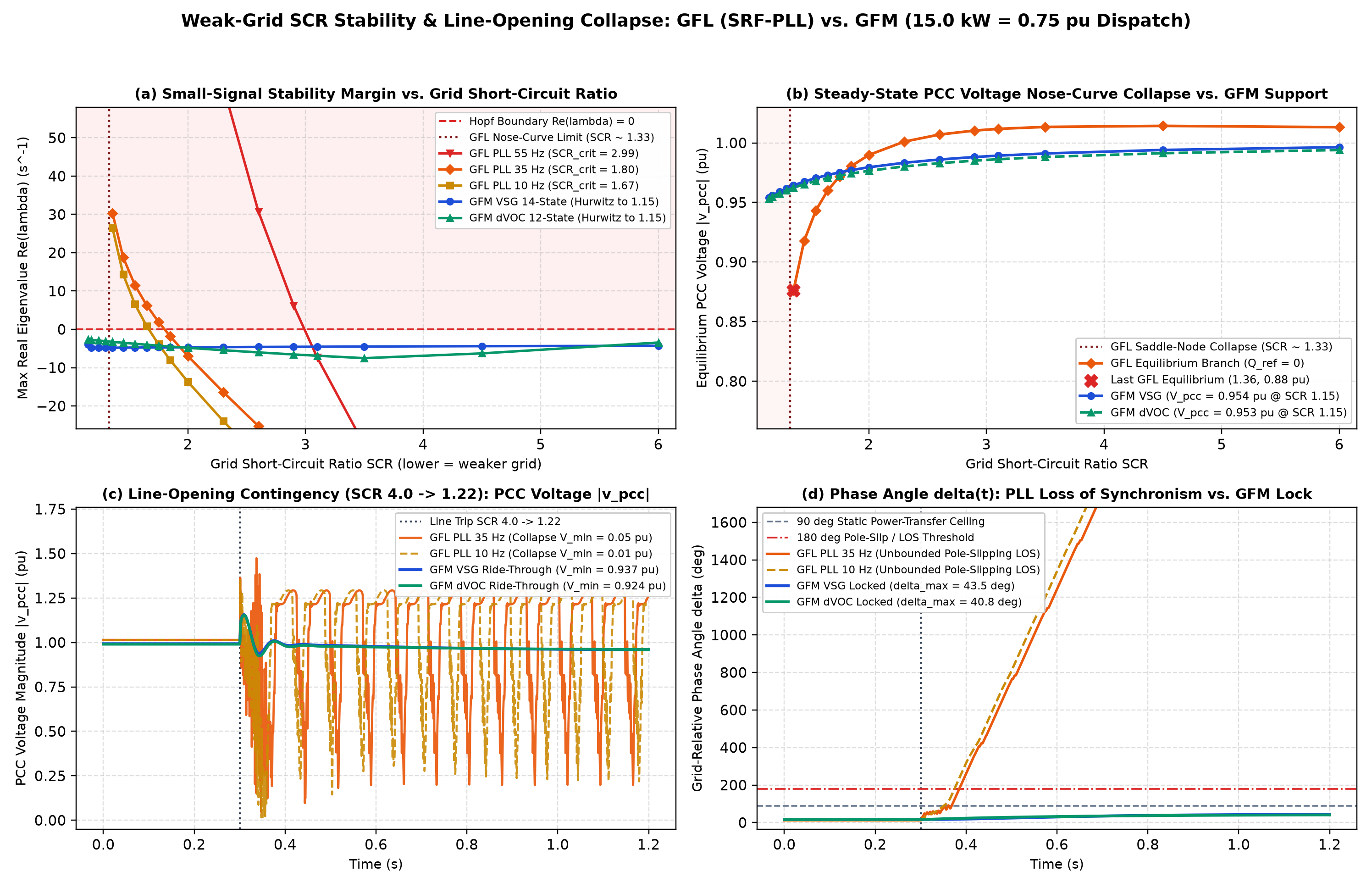
GFL Hopf instability at SCR_crit = 2.99 / 1.80 / 1.67 (55/35/10 Hz PLL) and SCR 4.0 -> 1.22 line-trip pole slip vs. Hurwitz GFM VSG & dVOC ride-through.
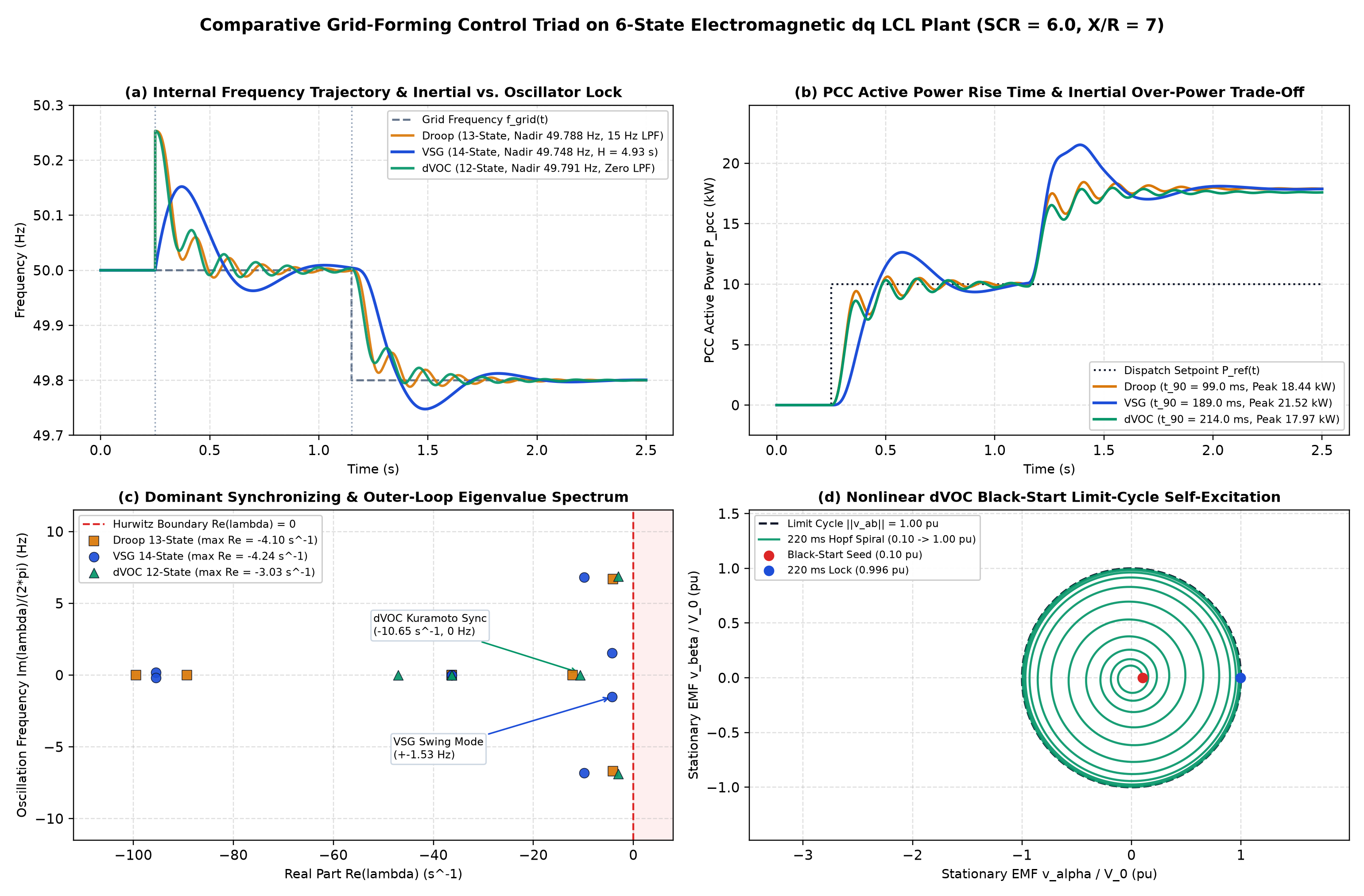
Droop t_90 = 99 ms (18.44 kW), VSG inertial support (21.52 kW, 49.748 Hz nadir), and dVOC exact Bernoulli black-start limit-cycle self-excitation.
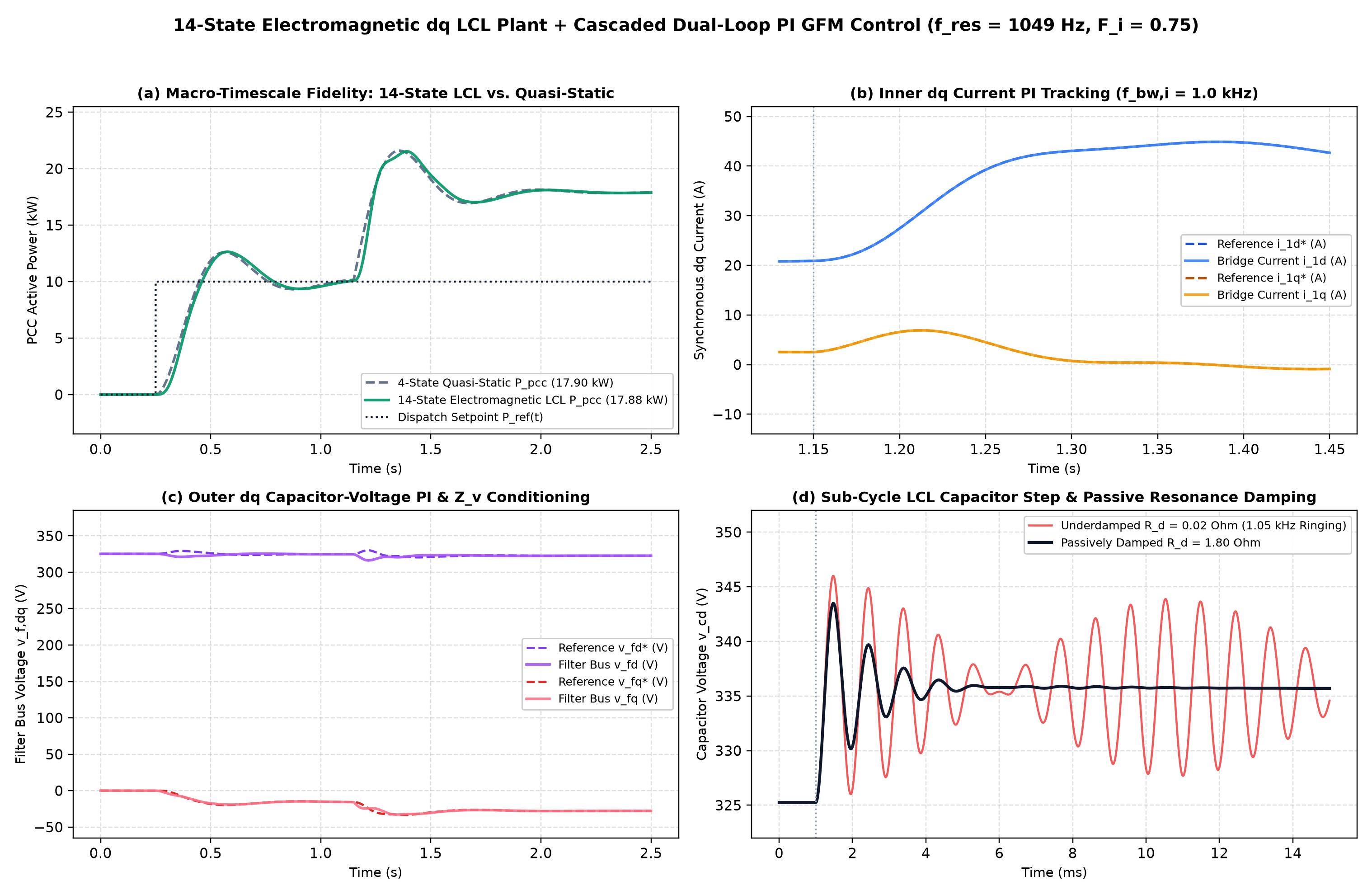
Cross-timescale agreement against the 4-state Thévenin model plus passive R_d = 1.8 Ohm suppression of the 1049 Hz LCL resonance.
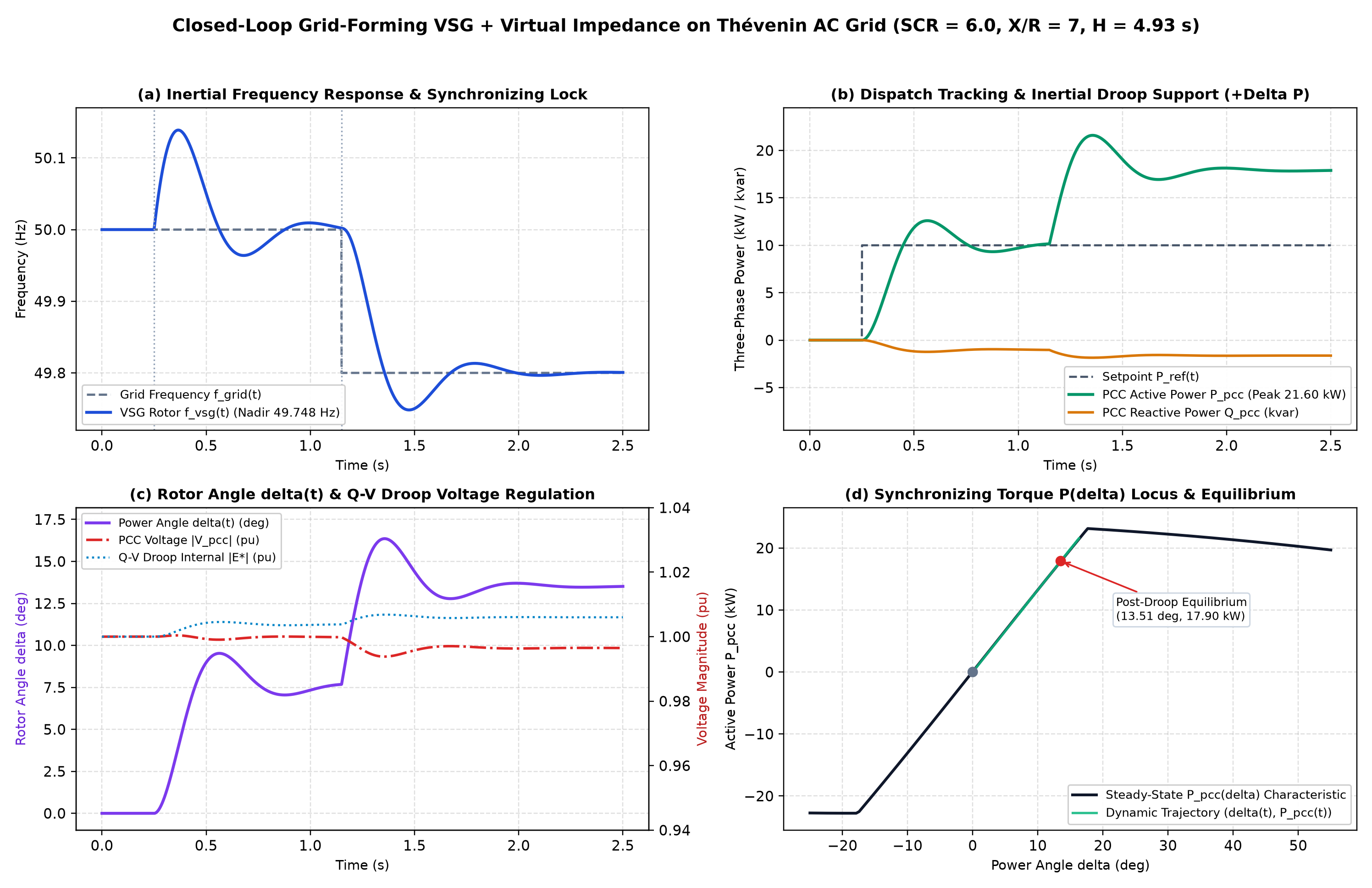
20 kVA / 230 Vrms canonical RoCoF & load-step transient: Nadir = 49.748 Hz, Peak P_pcc = 21.60 kW, Final settled P_pcc = 17.90 kW.